News
History: Overland Trail and Overland Stage


Last week this column looked at the Overland Trail. This column looks at the travel along the Overland Trail, namely the Overland Stage Line, which carried passengers and mail from Kansas to the Pacific.

Before the coming of the railroad, the stagecoach was the faster way to travel across the country. But it wasn’t always the most comfortable.
This from The Laramie Daily Boomerang, January 4, 1911.
One of the pioneers of Laramie, who crossed the trail in the stage in 1864, said that the stagecoach was a very good place in which to become acquainted, since it took Aye days to make the journey from Salt Lake to Cheyenne. The coach traveled both day and night, which made sleeping almost impossible. In the coach with this pioneer, there were two women and two little girls, besides four or five men. The man of whom I have just spoken, said that he sat in the middle seat of the coach. This seat has a large strap for the back and a large strap suspended over it from the ceiling. This really was-the hardest seat for riding. Besides riding in this uncomfortable seat, the pioneer passenger held one or the little girls on his lap almost all of the journey.
As he had not slept at all on the way from Salt Lake to Mutton’s station, he was fairly worn out. Upon reaching the station he bought some villainous whiskey from Mr. Wilcox, who kept a small store at that place. The whiskey was vile, but never the less it put the weary passenger to sleep until the coach reached Cheyenne.
Up to this time I have not mentioned the game which could be seen along the trail. One band of antelope seen from the stagecoach near Rock Creek, numbered at least three thousand. Elk were very numerous. Frequently antelope were seen in bands or one huudred and two hundred. Coyotes were also seen occasionally. In the early sixties buffalo roamed the plains in large herds. One day the stage was detained between Sidney and Cheyenne for two hours and ten minutes by a herd stampeding buffalo.
It took that length of time for the buffalo to pass over the trail a herd about one-half miles wide. One winter a large herd of buffalo was caught in a snowstorm on the plains. The next spring it was not an uncommon sight from the stagecoach to see men with wagons picking up the buffalo bones to ship back east for fertilizing. At the time when the railroad had reached as far west as Carbon, three men on a bet killed one handred and four elk in a day. The bet was that they could kill one handred in a day.
The men left the railroad at Carbon and continued their journey a short distance along the trail. Soon they came upon a large herd of elk. The men stationed themselves near the herd. When the elk were “churning” the hunters shot them down until they had one hundred and four. Leaving the animals lying on the plains, the men returned to Carbon. One of these men was a desperado named Jack Watkins.
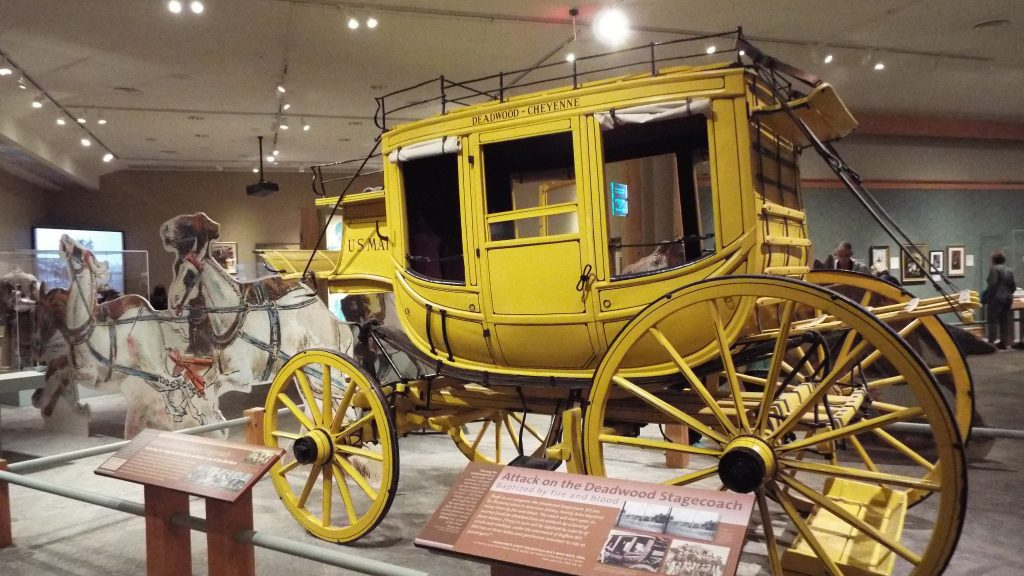
The Cheyenne-Deadwood Stagecoach at the Buffalo Bill Center for the West in Cody. Bill Cody was, for a time, a driver on the Overland Stage.
And this article in the Sheridan Post July 16, 1922, talks about the Overland when Ben Holladay owned the line.
Develops Greatest Stage Line on the Globe When the government decided to contract for the overland mail service the contractors sent out long wagon trains to transport supplies across the plains to various stage stations on the frontier. It required a train of 25 to 30 wagons to haul an enormous quantity of these to feed the army of employees, the hundreds of head of stock and the passengers.
It was necessary to have at each station extra teams for use in case of losses incident to the perils of 1,000 miles of wilderness,
The speed with which the stations were built and equipped was considered remarkable. With the exception of a few weeks in each of three years—1862, 1864 and 1865— there was no interruption of the daily overland mail running between Atchison and California for above five years. It was the greatest stage line on the globe, and the genius who developed it to its greatest success was Ben Holladay, who had a long and notable career on the frontier and was possessed of a remarkable ability as an organizer and executive. He employed the most experienced stage men in the country. He bought, regardless of price, the finest horses and mules of the type best adapted to staging.
He equipped his stage line with the best vehicles obtainable. These stages, built in Concord, N.H., were designed to carry nine passengers inside and one or two on the seat with the driver. As many as 15 passengers were carried at times. In 1868 the fare from Atchison to Denver was $75. (Today, an interesting side note here, according to AAA gas cost calculator, driving a Chevy Equinox, the cost would be the cost is about the same, $76, but would take one day.)
Later it was increased to $125, and then to $175. Collateral lines were established north and south. The fare from Atchison to Virginia Montana, in 1866, was $300. (Today, the cost would be approximately $185.) The fare to Salt Lake that year was $250. (Today, approximately $150, and it would take about two days to make the trip)

Diorama in Wyoming State Museum in Cheyenne.
The first contract for carrying mail from Atchison to California and intermediate points was for $1,000,000 a year, Later the compensation was reduced to $840,000.
Among the remarkable fast stage rides across the plains during the overland days was one made by Holladay from California to Atchison. He received a telegram to go to New York the quickest time possible. He sent word head to his division agents to have everything in readiness and made trip by special coach from Placerville to Atchison, a distance of 2000 miles in 12 days and two hours, beating the regular daily schedule by five days. (Today, according to AAA, the trip would take 24 hours and 45 minutes)
Holiday’s Fast Trip on Overland Cost Him $20,000 This was a somewhat expensive journey, the cost in wear and tear of stock, vehicles and other expenses amounting to $20,000. However, Holladay considered it to be a great advertisement for his stage line, being the quickest trip ever made across the plains excepting by pony express. Holladay remained at the head of the Overland line for five years. In the latter part of 1866 he disposed of livestock and all other equipment of the line to Wells, Fargo & Co., which firm soon had exclusive control of all express and stage routes between the Missouri river and the Pacific coast.
The stages were often attacked upon by Indians, or held up by outlaws wanting quick wealth from robbing the stages of whatever valuables were being carried, including robbing the passengers.
On the Bitter Creek division, between Denver and Salt Lake, a stage was held up and robbed of $60,000. On the coach in which Ben Holladay was riding was held up. Holladay had a few hundred dollars in his pockets and $40,000 in a money belt, besides an emerald pin in his necktie that was valued at $8,000. He managed to save the $40,000 and the pin, and lost only some $300.

Diorama in Days of ’76 Museum in Deadwood, SD
Completion of Union Pacific in 1869 Ended Overland Stage Service The completion of the Union Pacific line on May10,1869, ended the overland stage service and one of the most picturesque periods of western frontier history. Many tributes have been paid to the old stagecoach. The following appeared in the Atchison Champion a quarter of a century after the overland route had closed to staging: “The old stage coach has ended its career —made its last trip. Here and there what remains of it stands beneath the rickety shed of, some wayside inn, a relic of bygone days — weather-worn, storm-battered, rusty and abandoned. Its leather springs are cracked and broken, its doors gone, its sides and back smashedin, its boot the refuge of rats and bats; its wheel bent, its axle-trees twisted —a poor forlorn remnant of its former proud and glorious self.
Ghosts of a buried past now hide in it. Shades of the occupants it carried once have en-wrapped it. Spectral forms of the road agents who once surrounded it to rifle the contents of its boot now troop around it when nightly shadows enfold it. The old brake that so often and so faithfully checked its down-hill speed, grating out assuring, harsh sounds to the traveler’s ear when the road was steep and dangerous, is bent and broken and useless now. The mated steeds that drew it over long, weary, dusty miles are gone. In the seats where the worn and exhausted journeyers once slept, nightmares now revel. The imperious and impressively confident driver is gone. From his nerveless hands the lines have fallen, and the shrill notes of his horn have died away on the air of the vanished years. Poor thing! There it stands under the old tavern shed, wrecked, dismantled, forlorn….
No one hails its coming with eager, beating heart; no one weeps as it rumbles away with its precious freight of affections and friendship….
Had it tongue to speak, what forgotten stories it could tell… what history it could disclose.
The Overland Trail and the Overland Stage Line, a romantic part of the history of Wyoming and the West.
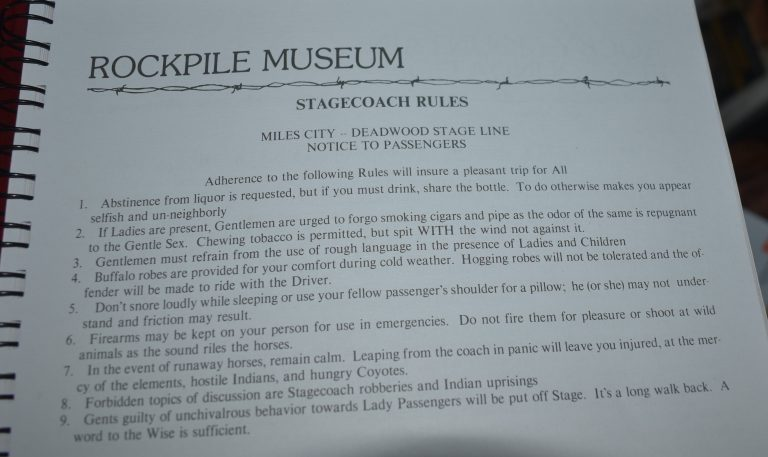
Although these rules were for the Miles City to Deadwood Stage, they would have been similar to all stage lines. Thanks to the Rockpile Museum in Gillette and the book, Past, Present and Posterity.
Feature photo – Diorama at the Days of ’76 Museum in Deadwood, SD. With thanks.