News
March is National Quilting Month

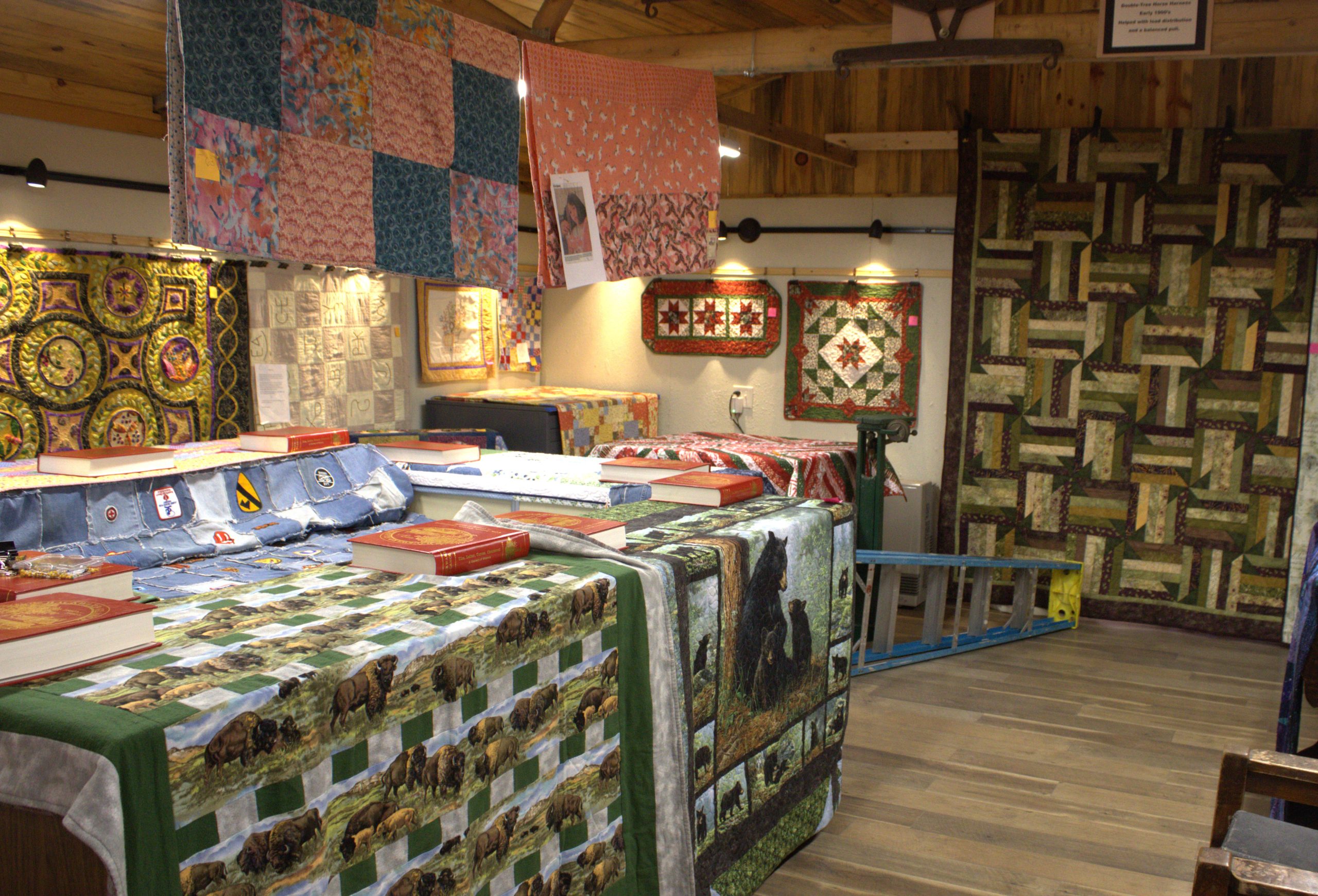
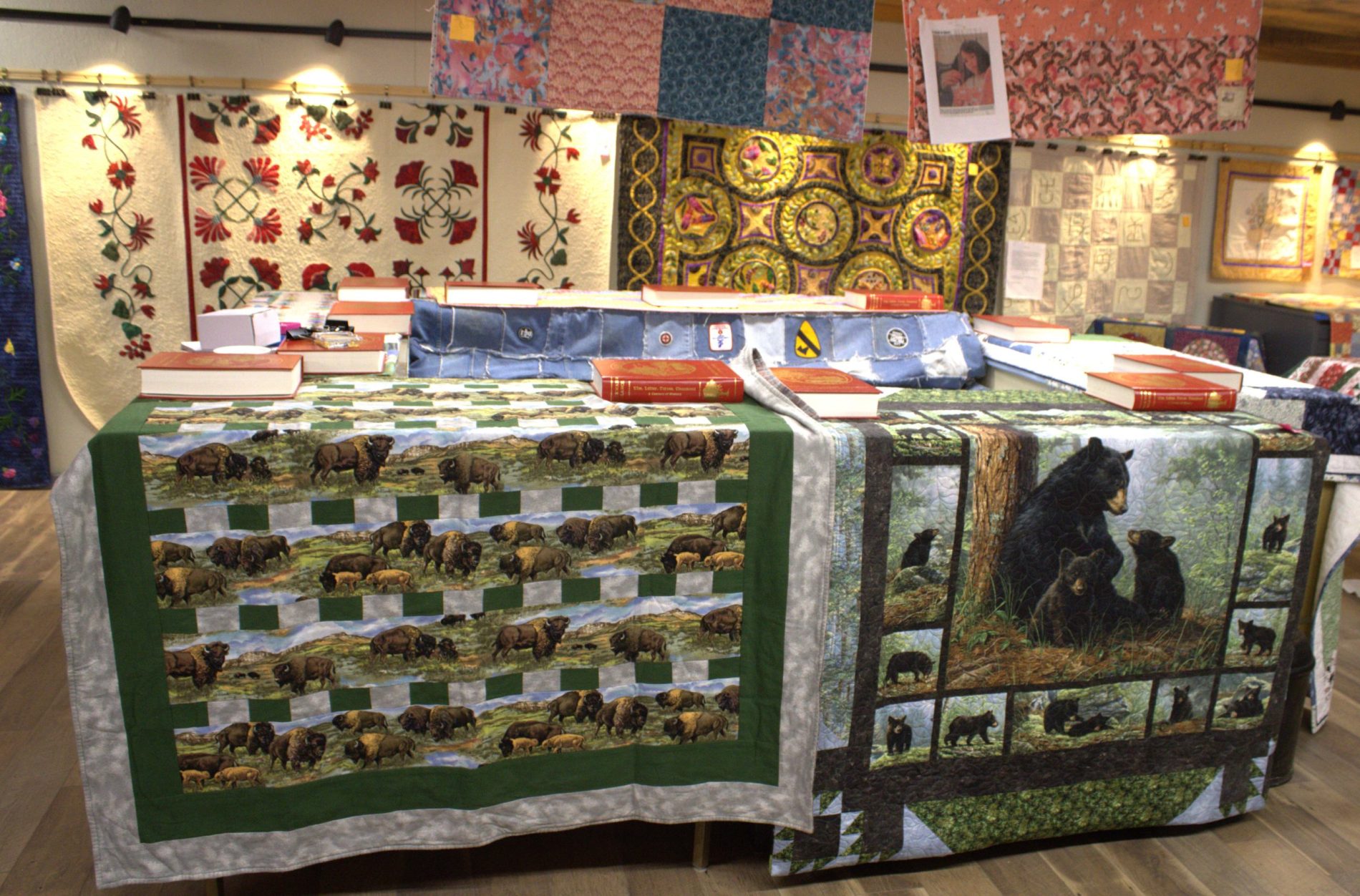
March has been designated as National Quilting Month, and March 21 is National Quilting Day. In Clearmont, there is a month-long quilt show at the Clearmont Historical Center, and on Saturday, March 14, there will be a quilting bee held by the Clearmont Women’s Club at 9 a.m. at the Clearmont Community Center.
Let’s look back in time to some of the history of quilts and quilting.
The making of quilts, that is, stitching together of layers of padding and fabric, may date back as far as 3400 BC. Quilts have been used as bedding, and for warm clothing.
A quilt is sort of a sandwich, consisting of a top, usually made my sewing together squares of colorful material, or using a printed material; the batting, or the filler to make the quilt warm, and the backing, a large piece of material sewed on the backside of the quilt. The batting is usually cotton and polyester and is purchased in large rolls. Historically, batting could be wool or cotton. Silk can also be used as batting, anything that helps to make the quilt warm.
The backing is laid out on a large table, and the batting laid on the backing, and the top is then sewed onto the backing, with the batting in the middle. The backing is usually at least 8” longer and wider than the pieced top, to allow the quilt to be sewed together.
After the backing is tacked on to the top, the quilts are then placed on a frame, a large structure that holds all three parts of the quilt: the quilt top, the batting, and the backing. The frame acts as a pair of helping hands, keeping the quilt taut as you work, sewing it together and doing the ties, colorful yard knots that add texture and help to hold the quilt together.
With the advent of sewing machines, quilting fell out of fashion for a time, but there were several eras, including the present day, when quilting was revived.

The Rawlins Republican, March 14, 1895 – Real Quilting Revived Real old-time quilting, quilting done by hand and showing beauty as well as precision, has been revived. In common with much other fine, tedious work it dropped into disuse when the sewing machine invaded every home, but it has returned, and with even more than its original charm. The very latest spreads for infants’ use are of soft India silk, elaborately quilted, and are very attractive indeed.
A fine specimen seen this week is of robin’s egg blue, lined with creamy white. It is tufted with real down and is warm, while it is neither clumsy nor heavy. But the quilting is the distinctive feature, and that is done as perfectly as quilting can be. The pattern is quite as elaborate as any designed for braiding would be and of the same general sort. Instead of being covered, however, it is traced with the finest possible stitching, all put in by hand.
In itself it completely controverts the theory that the art of needlework is dying out. Not even relies of our great grandmothers’ time can show any finer work and few can boast so handsome and elaborate a pattern. Whether one believes or does not that the result warrants the time expended and the strain upon the eyes, she is forced to admit that the spread is exquisite and dainty. The stitches are marvels, for each one is of exactly the length of the last and even the machine could not do more regular work, says the New York World.
To a woman born and bred in the last two decades the spread seems a wonder of patience as well as skill. Investigation into the realm of the long ago and a little searching among the treasures of our great-grand mothers’ time may reveal similar things, but to modern eyes it is marvelous nevertheless. To be sure a revival of fine hand work has been on the cards for some time past, and it is and has been, quite correct to allow such stitching a place anywhere near the sensitive skin. Notwithstanding this fact, however, the elaborate quilting is new to the present generation, and a more genuine novelty than such a revival is difficult to find.
This from The Laramie Republican, November 28, 1913 – Quilting Parties Again the Mode. Once more the old-fashioned quilting ls coming back to us. though not with all the elaborations which distinguished this treatment 200 years ago. Then bed covers and many articles of dress were quilted in most minute designs, often most attractive. Pearls are introduced now at each point of the quilting, and fur ls a good addition, and with white and light-colored satin, for example, fur is not considered unseasonable, especially sable. when the purse will run to it.
Bunches of flowers, animals, birds and fishes found a place in the quiltings of old days, but these are not us yet revived. Many a wedding dress new no longer which could not be worn again found a place as a quilt, most elaborately quilted, and was handed down for generations as an heirloom.
In this story, from the Laramie Republican, September 2, 1914 describes how to tie the yarn ties on quilts quicker. –Quick Quilting A home worker tells of her quick method for quilting She says: “Try this and you will never go back to the old way: Prepare a quilt or comforter for tacking, Be sure it is taut on the frame. Thread a large darner with the cord you choose to use. Tie the first knot, but do not cut it. In about two inches proceed as if to make another knot, only this time do the weaver’s knot with the needle. Do this clear to the end of the comforter, then cut between each space, and your work is done This is perfectly original with me “

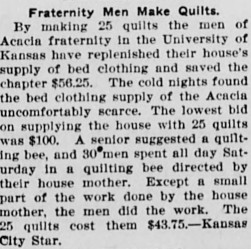
Even men got into quilting. This from the Lander Eagle and Riverton Chronicle, July 12, 1917
Another story that appeared in the Wheatland Times, September 22, 1915 – Memories of Quilting Time. One of Life’s Simpler Pleasures That May Be Classed with Things of the Past. Probably we don’t have much of it in the cities anymore, perhaps there never was much of it done in the cities, but out in the country and in hamlets and towns quilting time used to be an occasion of merriment combined with utility; it was in the early home what the log rolling was outside. It had a place and prestige along with the sugar making, with the husking bees and the apple cutting, the comfort knitting and a lot of other happy functions of an earlier day.
Today we buy our comforts and our sugar and practically everything we use; we have our corn husked in the field, either by hired hands or machinery; we live in a hurrying, labor-saving age, and maybe we have sacrificed much of quality for quantity, value for something esteemed more pleasing to our aesthetic senses. But the old fashioned quilt which would withstand the kicking of lusty young savages in the attic bedroomfor at least a year, was some quilt. Mothers and aunts, sisters and nieces, neighbors and friends came into help make it; the home became a social center, where quilts were made and perhaps where some little gossip at the expense of absent ladies was indulged in. Usually, at such times, there was something good to eat, rather better than the ordinary bill of fare, pre pared — and that’s where the kids came-in for a good time, though often they had to wait, like Lazarus, at the gate, or door, until their superiors had feasted, when they fell to and left not even crumbs. Quilting time was always a fine time; perhaps the snowflakes were flying, but usually the work was done along about the time the bees were buzzing and the flowers were in bloom, with the sun beams flashing from the flying needles. – Evansville Courier
Quilts are still being used today, and many are fabric works of art.
So, in March, drop by somewhere with a quilt display, and see the work that can be done by an experienced quilter. Or, find a quilting bee and help out. There is yarn to tie, piecings to iron, and other fun tasks that the quilters would welcome help with.