News
History: Hot Summers in Sheridan

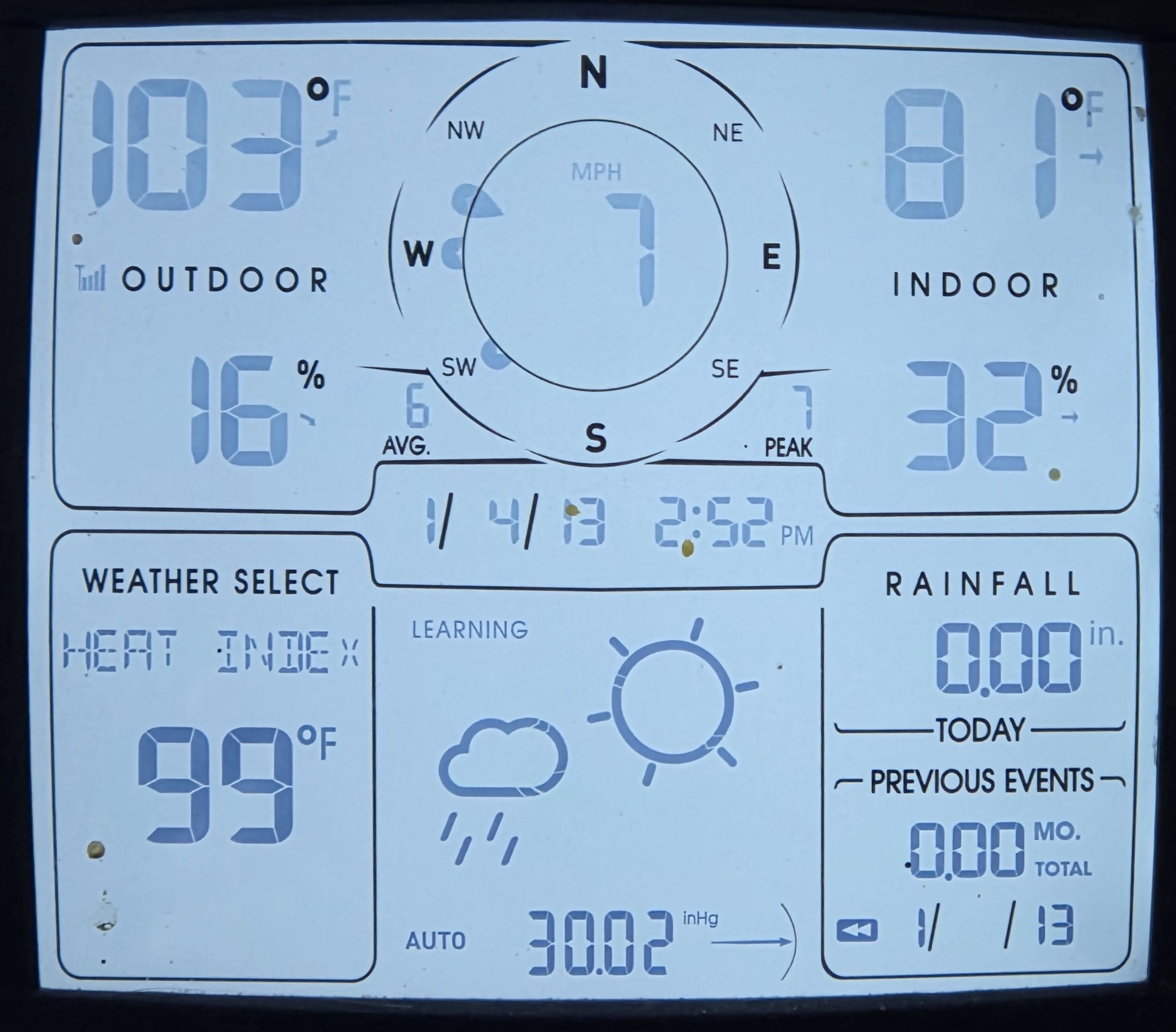
The Sheridan area is no stranger to hot summers. With the mild, warm winter we experienced recently, is it any wonder that summer is starting out hot and dry?
Here is a look back at some other hot summers in the area.
The Sheridan Enterprise, August 2, 1918 – 92 Degrees in Shade is Recorded – Sheridan yesterday felt the intense heat of August when tho thermometer reached a maximum of 92 degrees as recorded by the local Weather Bureau station. The unofficial thermometer downtown, however, reached as high as 98. The record for the highest temperature in the month of August ever recorded was in 1908 when the thermometer reached the unusual temperature of 100 degrees recorded by the Weather Bureau thermometer.
The temperature at the Weather Bureau was registered during this afternoon at 1 o’clock with prospect of a hotter day than yesterday.
On thing about Wyoming, being a dry climate, sometimes one can get some relief in the shade, but it can get hot in the shade as well.
The Sheridan Enterprise, June 23, 1919 – Sheridan has Hottest June Day on Record 101 inShade Reached Here Sunday, which is Two above Old Record. – Hot weather records for the month of June were shattered yesterday afternoon when the mercury at the local United States weather bureau reached a maximum temperature of 101 degrees. Saturdayafternoon the mercury climbed to 100 degrees, which was one degree hotter than has ever been recorded in Sheridanduring the month of June. The record, prior to this year, was 99-degrees, recorded inJune, 1910. Sheridan sweltered in the shade yesterday Only a slight breeze stirred during the day. Scores say residents sought refuge inthe mountains, all mountain resorts being crowded throughout the day. Many home thermometers recorded hotter weather than was registered at the weather bureau. Many climbed to 106 degrees in the shade while others, whichwere less sheltered, boiled to 113. Cooler weather for tomorrow is forecast by the weather bureau.
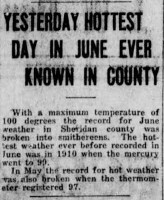
The Sheridan Post, June 22, 1919
Extreme heat can be dangerous, especially in the Midwest and East where the humidity makes the heat that much worst.
Bill Barlow’s Budget, July 3, 1913 – Sweltering Humanity Middle West And Atlantic States in Heat’s Death-Dealing Grip – The past week has been one of great suffering and loss of life caused by the extreme heat that has continued during that time. Reports from various parts of the country show nearly 100 dead; prostrations by heat unnumbered.
Chicago reported the mercury at 102 degrees, where there were 46 deaths officially reported, with more than 200 prostrations. At Tucson, Arizona, the mercury was reported at 102, while Pierre, S. D., sweltered at 107, Washington, D. C., 94, Portland, Me., 02. New York 87, Boston 89.6, with an 82 per cent humidity. Fatilities due to the heat are reported at Hibbing, Minn., Milwaukee, St. Louis, Grand Rapids, Detroit, Cleveland, Chicago, New York, Portland. Me., Cincinnati and scores of other places, showing how general has been the heat wave.
In Chicago, Boston, New York and other large cities the parks, beaches, roofs of buildings and even the sidewalks are sought for relief, while the harbor and excursion boats were packed with suffering humanity. The eastern sections of the country were given some relief Saturday by a breeze from the east – “a sea breeze” but otherwise the country generally is still suffering.
At Peru, Ind., the intense heat caused rails to spread on the Chesapeake & Ohio Railroad, wrecking the “Fast Flying Virginian,” injuring 25 persons near Fulton. Two Pullmans and a diner turned completely over, but none were killed. At Mitchell. S. D., a passenger train was wrecked owing to heat effect upon the rails. The train was on its way to take on old veterans for the Gettysburg reunion. Two persons were injured when four cars on a St. Louis &San Francisco fast passenger train left the rails near Tulsa, Okla., stopping up right onthe brink of a 20-foot embankment,
A defective rail was the cause of the accident, probably attributable to the heat. At Joliet, Saturday, four persons died and seven more are reported near death, with the mercury at 99 degrees. At Peoria heat caused the death of six persons and ten were prostrated, with the thermometer at 109 degrees. In parts of Kansas, Oklahoma and Nebraska light rains brought relief after several days of extreme heat.
This next story is interesting. Although, today, we newer electronic equipment to measure the temperature, the glass tube with mercury or red-colored alcohol were the standard for many years, and are still in use. This story in The Sheridan Post, July 26, 1910, talks about the glass thermometer.
Concerning Thermometers – At this season of the year, when temperature plays so important a part in the comfort of the people, it may be of interest and of benefit to many to have placed before them a few of the essentials of a good thermometer. A good thermometer, like a good man, is characterized by a high rate of working efficiency under all circumstances, whether the temperature be high or low.
This being true, it should not be assumed that we suffer from heat because the thermometer indicates a temperature of 100 degrees in the shade, as ordinary thermometers are usually in error several degrees during high or during low temperatures. It is with a view to correct false notions respecting thermometers that a few facts are set forth below. Most if not all of the household thermometers on sale at stores have the scale of degrees on a metal strip to which the thermometer is attached.
This scale is uniform throughout. A standard thermometer has the scale on the glass stem, and seldom are the spaces between degree marks uniform throughout.
The bulb and the stem of ordinary thermometers are of the same glass, while the bulbs of most accurate thermometers are from harder glass than is the stem. In the manufacture of cheap thermometers, the glass tubes and the scales are made up in wholesale lots, and the tubes are fitted to the scale at a temperature of 70 degrees. The further from this temperature you go, above or below, the greater becomes the error in the indication of the thermometer.
A glass blower seldom is able to blow a cane of glass with the bore of uniform thickness, hence it is inaccurate to place the scale independent of the glass tube, as equal increments of heat at the bulb will not result in equal extensions of the mercurial column in the stem. The scale of degrees on the stem of a good thermometer is adjusted to suit the variations in the diameter of the bore of the stem so that at any temperature within the limits of the scale, the addition or the loss of a given amount of heat will show a rise or a fall of the same number of degrees on the stem.
Again, the diameter of the bulb bears a definite relation to the length of the stem or scale; a precaution taken by the manufacturer only in high grade instruments. So. when our friends add to our discomfort by reading the thermometer to us at midday, we can console ourselves with the though that, like a large portion of genus homo, the thermometer behaves thus became of the lack of care in preparing for its usefulness.
So, the best way to keep safe in extreme hot weather is to limit time outdoors during the heat of the day. Take advantage of air conditioning, swimming pools, the mountains, which are normally cooler, and even shade helps some.
Welcome to summer in Wyoming, and everyone be safe out there.