News
Third Annual Archaeology Fair at Fort Phil Kearny


Digging up history; learning about Wyoming’s prehistory; learning flint-knapping; having artifacts examined by an expert, and throwing the atlatl were all a part of the third annual Fort Phil Kearny Archaeology Fair on July 26th.
Archaeologist Dave McKee, President of Fort Phil Kearny/Bozeman Trail Association, gave a short presentation on the prehistoric history of Wyoming.
Dave McKee’s presentation was a brief introduction to archaeology of the Northwest Plains entitled “12,000 Years In 20 Minutes”.
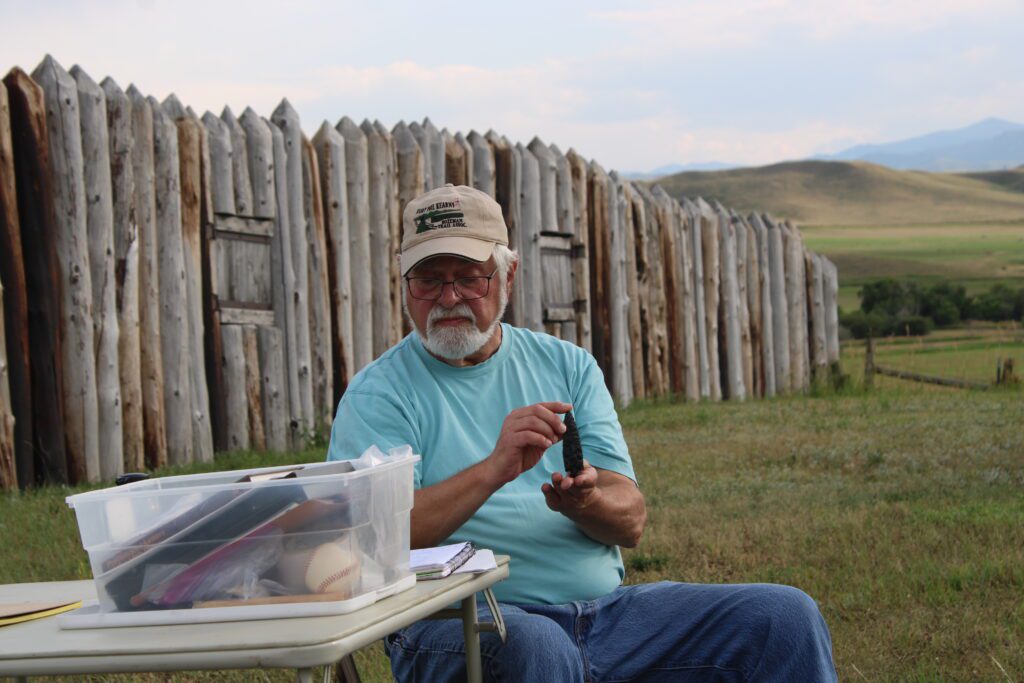
He asked the audience to close their eyes and visualize a place where they liked to hike, and to imagine finding an artifact. He asked them what questions they would have about their find. Who made it? When did they make it? How was it used? These are the basic questions that archaeologists ask when learning about the history of those who have come before us.
McKee talked about why he felt that history is important.
To explore more current Native American history, McKee talked about visiting with tribal elders and tribal historians who store knowledge about past generations.
He added that for the historic record put down by the cultures who have a written language, there are journals and diaries and county records. But the prehistoric record is different.
To accurately interpret prehistory, when one finds the projectile points, it helps to also find other artifacts in context. Location and undistributed setting is the key to unlocking the past.
He said some sites are like a layer cake, with the oldest sites on the bottom, and the later sites are higher up in the soil. He mentioned the Medicine Lodge Creek Site near Hyattville, Wyoming, which has been occupied for hundreds of years by Native tribes.
“It is a wonderful opportunity to contrast and compare the different levels and cultures of the different time periods.” McKee talked about several buffalo kill sites not far from Sheridan, and said they could tell if a hunt was held in the fall due to examining the teeth of the immature bison found at the kill site.
He added that the Native American’s in Wyoming did not live in isolation, even before they acquired horses. There was a great deal of trade happening across North America between the tribes during the prehistoric period. Pottery from the Missouri River Basin is found in Wyoming, and Wyoming obsidian has been found all over North America. He added that no only were goods exchanged, but also news was passed on from tribe to tribe.
Although archaeologists don’t concentrate on the spiritual side of prehistoric people’s lives, spiritual sites were a big part of the Indian way of life, McKee said.
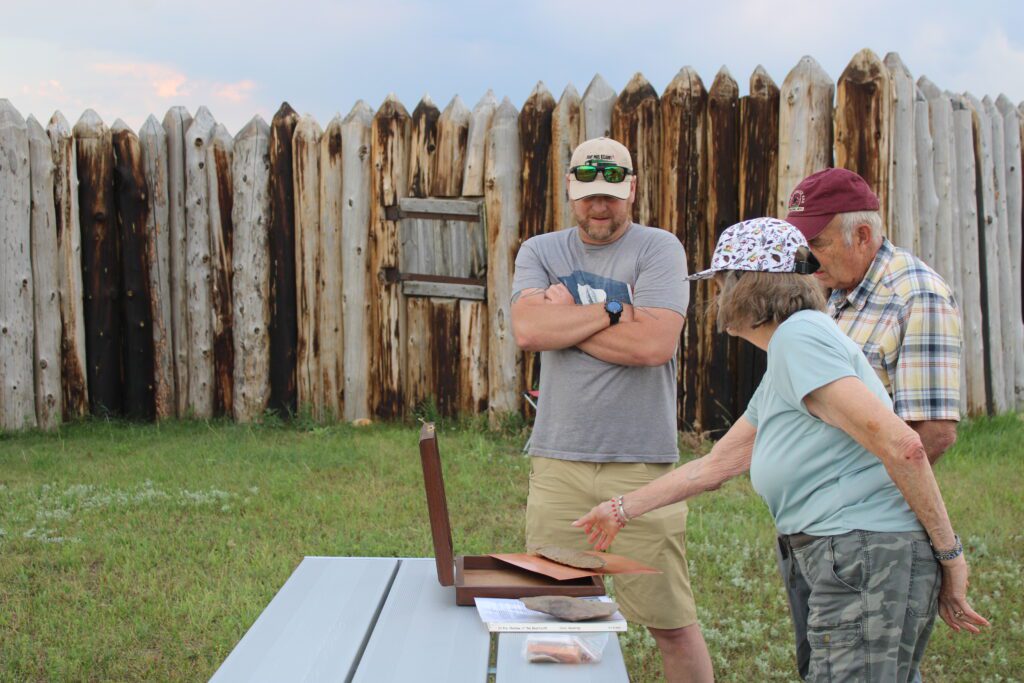
After McKee’s talk, the audience was free to talk to the other experts at the fair. Dr. Cody Newton, archaeologist, was on hand to identify artifacts that people were encouraged to bring. Rick Laurent demonstrated the art of flint-knapping to produce arrowheads and spear points.

McKee set up his atlatl throwing target, a buffalo painted on cardboard, so guests could test their skills as bison hunters. And Jenny Aello and Kristin Campbell shared the excitement of discovery with dig boxes for kids of all ages.

Campbell talked about what the youngsters learned when digging up the objects.

Around 25 people attended the event, held outside on the fort grounds.