
News
Echoes of the Apsaalooke at Fort Phil Kearny

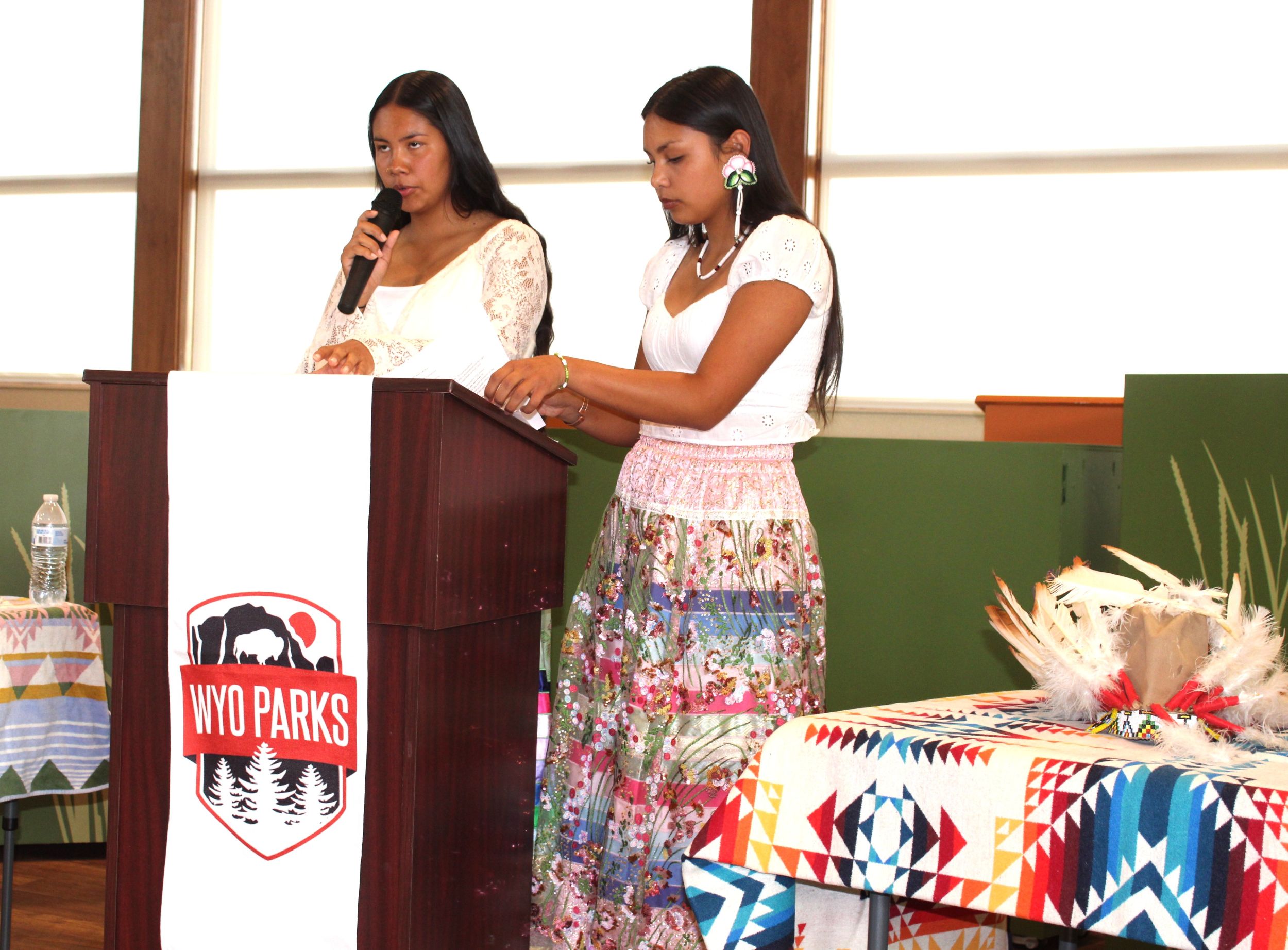
Every Native American Tribe has their own oral traditions, legends and stories that are passed down for generations. On Thursday night, August 6, Emaurice and Elannah Flat Lip presented “Echoes of the Apsaalooke: Collection of Crow Oral Narratives” at Fort Phil Kearny.
This is the second program that the sisters have given at the Fort, and the last one of the season for the American Indian Interpretive Ranger program, where Native American students work at the Medicine Wheel and present programs on American Indian Culture Fort Phil Kearny.
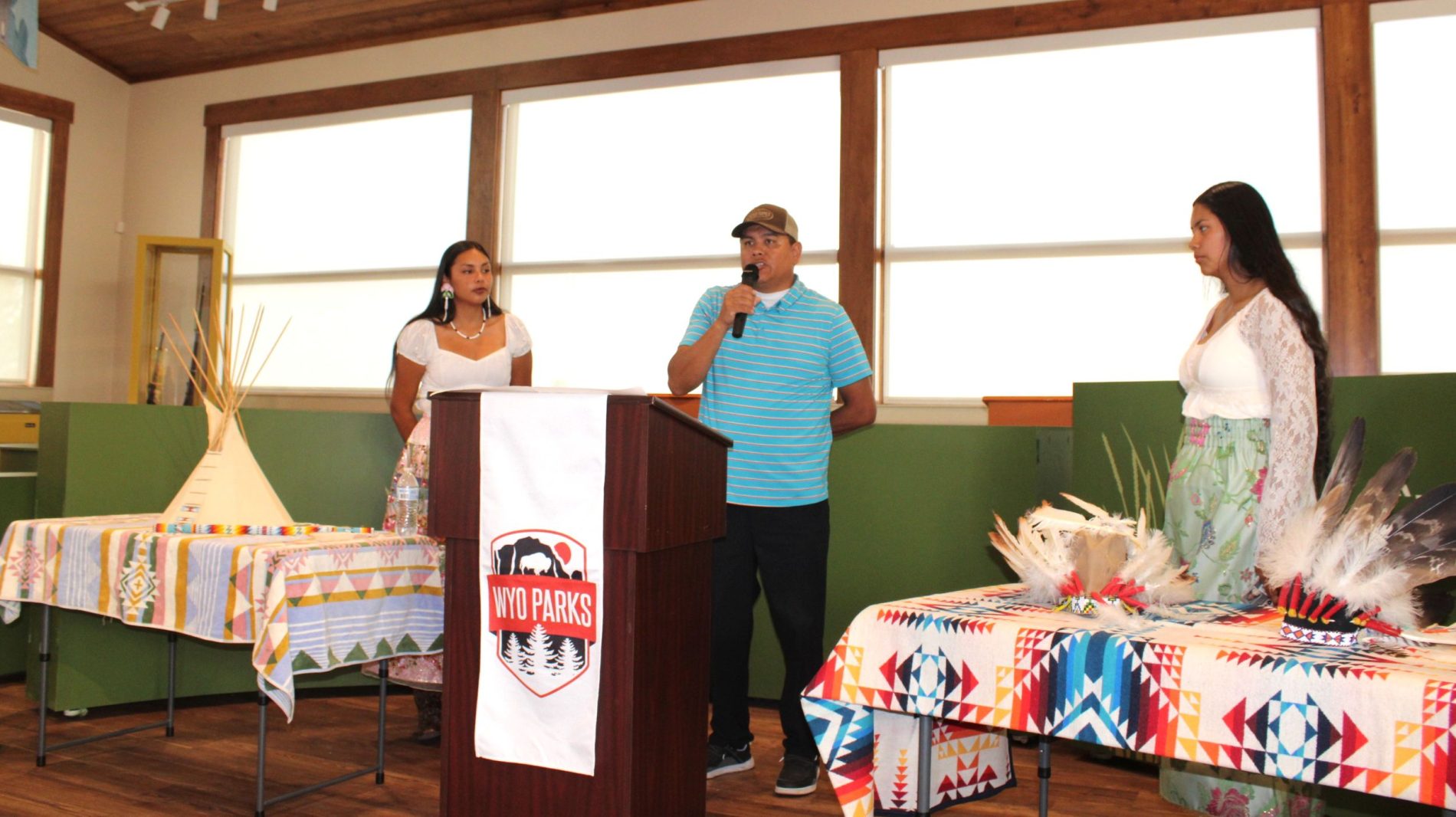
Dave McKee, president of Fort Phil Kearny/Bozeman Trail Association introduced the sisters before their program, and then turned the mic over to Elannah.
She started with the story of how the Crow got their name.
She added that at one time the Crow homeland was very large, and was given to them by the Creator. Emaurice explained about how the Crow tipi starts with four poles and what each pole represents.
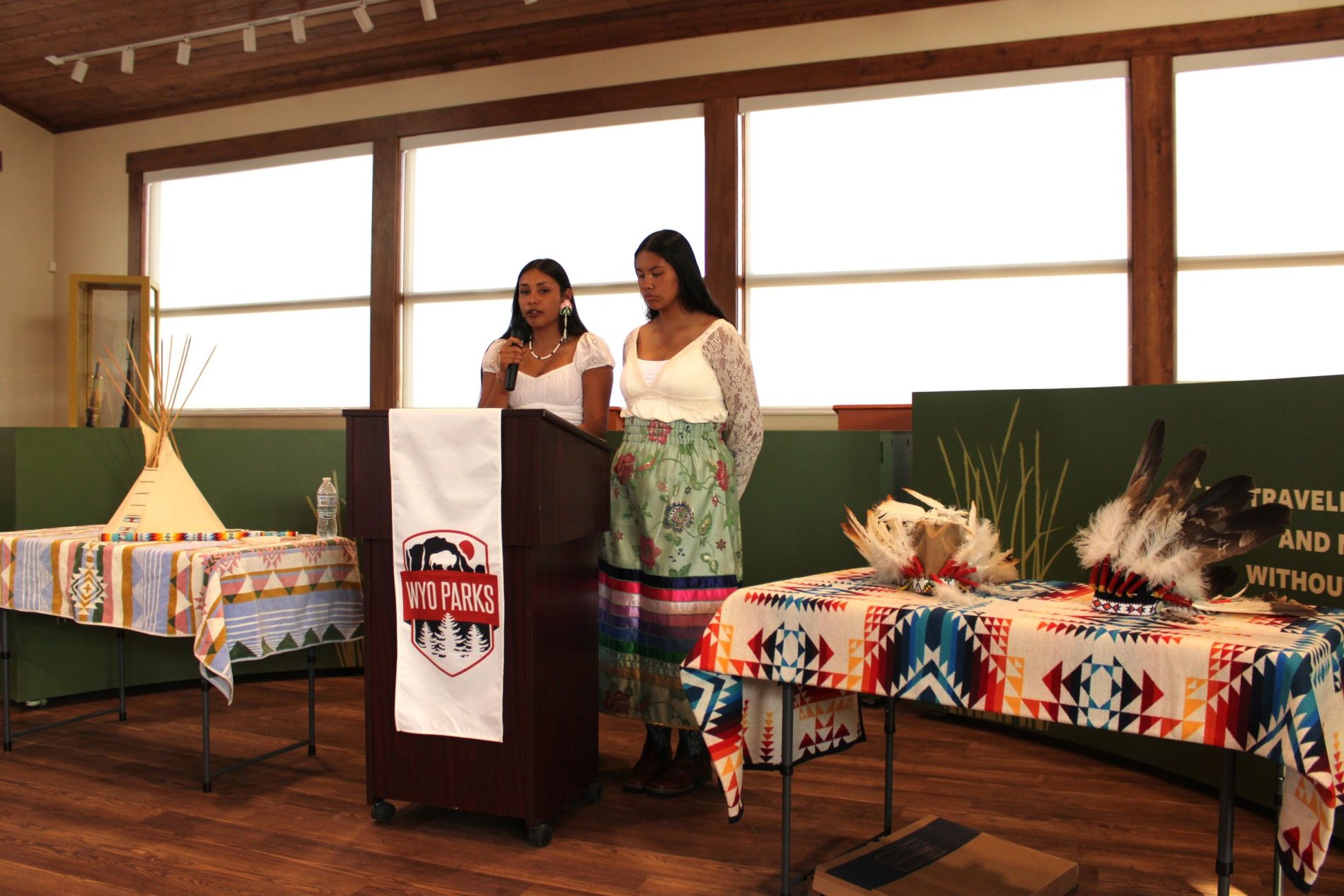
She added that the tipi is also a small representation of their ancestral homelands.
Elannah told the Crow story of creation, how the world was formed. At first, the world was covered with water. The Creator sent three ducks down into the water to bring him up some clay. The first two ducks said it was too dark under the water, and they could not find any clay. The third duck was down there a long time, but he came back up with a mouthful of clay, and the Creator blew on the clay, and it formed the vast land with mountains and rivers.
The Creator put the Crow in the Big Horn Mountains, even though they were a small group, they were a strong people and they would survive. The Big Horns are still sacred mountains to the Crow people.
They also told a story about Coyote, the trickster, and how is greed backfired on him. These stories were often told to the youngsters of the tribe to teach them values and morals.
The next section dealt with the survival of the Crow culture today. Elannah said,
They also talked about the Crow legend of the ‘Little People’ but that will be another story.
Another story they told was about Chief Plenty Coups, who was a chief that bridged colonization and the old ways.
The chickadee showed him in the vision the disappearance of the buffalo, and the coming of the cattle with the white men.
This vision represented the passing of the old way of life, and how the Crow had to learn to adapt and make friends with the white people, so that they would be able to stay in their homeland.
The chickadee also showed him a vision of a house, where he would live as an old man. Later, Plenty Coups built the house like the chickadee showed him, and he did live in it for many years. It is now preserved at the Chief Plenty Coups State Park, in Montana, about 40 minutes south of Billings.
Their father, Matt Flat Lip, sang a traditional traveling song as well.
They also talked about Crow Fair, which happens the third week in August, and will be held this year August 12 to August 17, 2026, at Crow Agency, Montana. They talked about some protocol that should be observed at the fair. Don’t park in someone’s driveway, and don’t take photos of anyone without their permission.
There are parades every morning and dancing under the arbor during the afternoon. All are welcome to attend, but she said they have to be considerate of the families that are attending, and do not park in a family’s driveway, or take photos of people without asking permission.
The program was well attended by around 20 people.
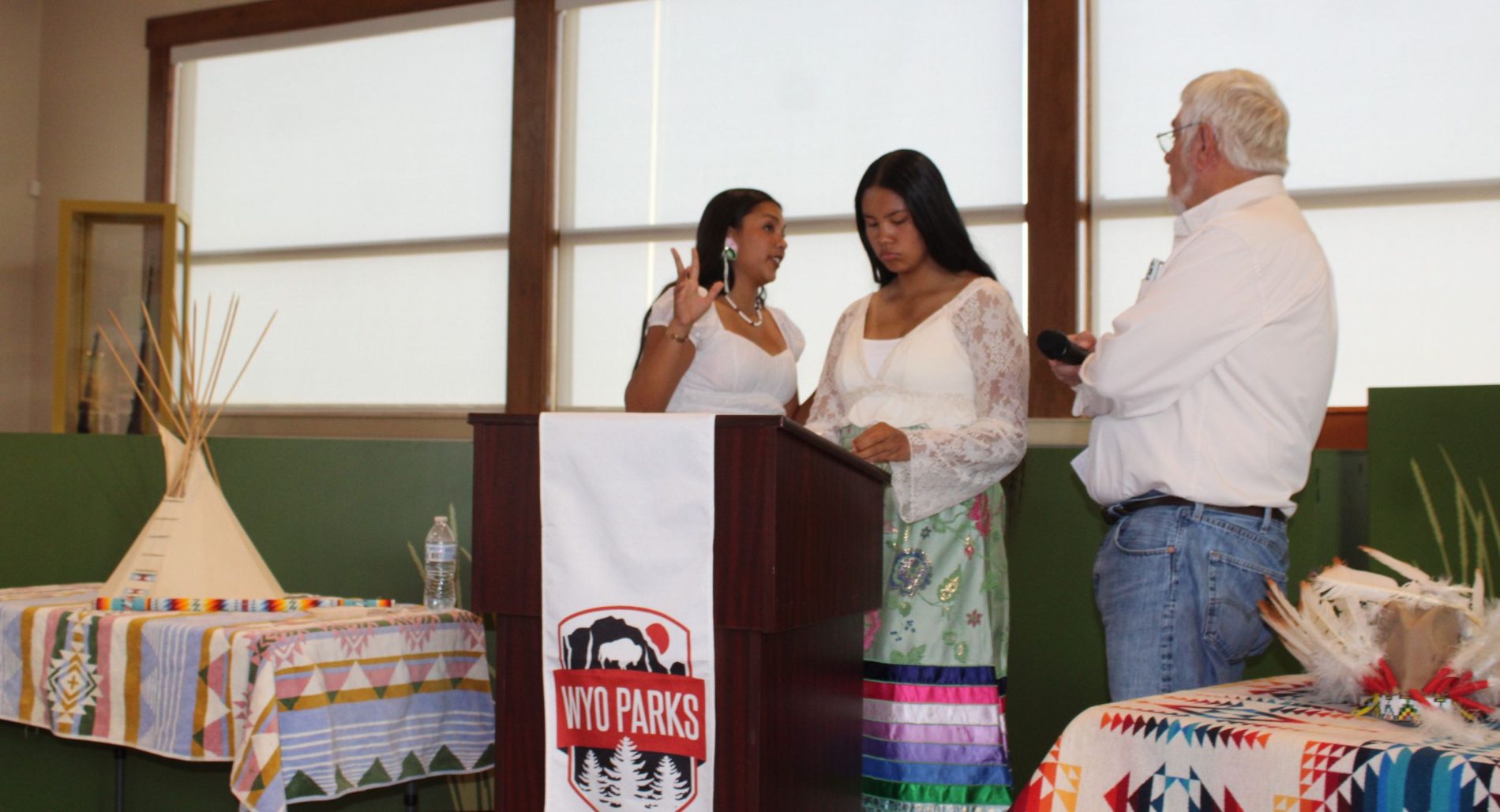
Dave McKee, president of Fort Phil Kearny/Bozeman Trail Association said that this is the fourth year of the American Indian Interpretive Ranger program, where Indian students work at the Medicine Wheel and present programs on American Indian Culture Fort Phil Kearny.
The American Indian Interpretive Ranger Program is continuing through the recently founded Medicine Wheel Preservation Group (MWPG), a 501(c)(3) organization with a mission to further public education, interpretation, and preservation of the Medicine Wheel/Medicine Mountain National Historic Landmark on the Bighorn National Forest and associated archaeological and American Indian cultural sites.
A key component of the MWPG is to continue to provide employment and career development opportunities for American Indian college students while providing American Indian voices and perspectives at the MW-NHL. The Bighorn National Forest and consulting parties voiced support for the program at the August 2025 Medicine Wheel consultation meeting.
Dave McKee is President of the MWPG, along with fellow board members JoAnne Puckett, Katie Curtiss, and Bill Yellowtail.

Danalee Bearrobe
August 8, 2026 at 1:41 pm
Very educational