alt
History: Grasshopper Infestations in Early Days

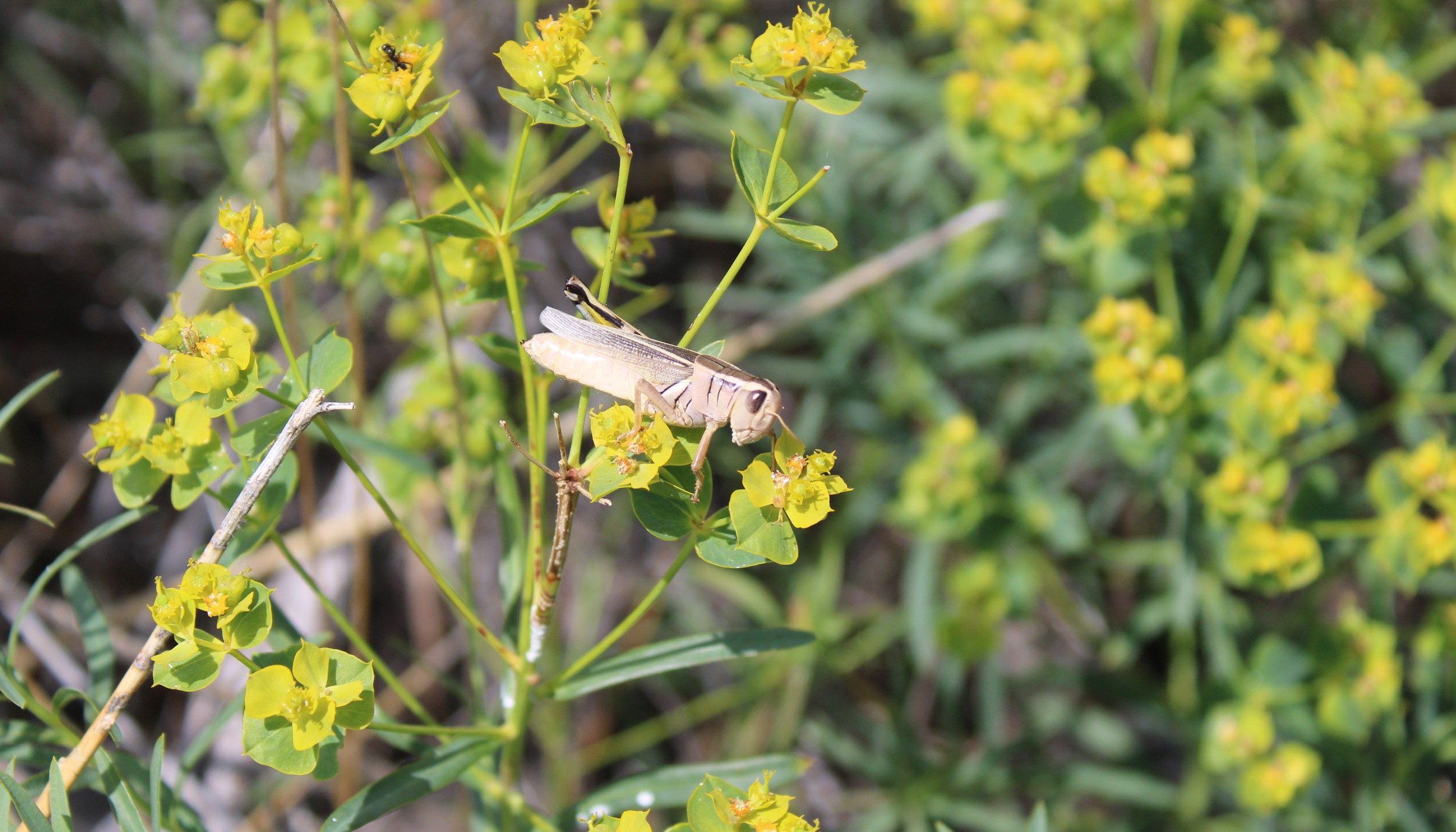
This year, with the warm winter and drought that is plaguing Sheridan County, it is the ideal climate for a devastating pest. Grasshoppers.
Grasshoppers have, periodically been a problem for farmers and ranchers for hundreds of years, in the United States as well as many other countries.
This infestation, although in Kansas, shows how destructive the insects can be, and some of the conditions that lead to grasshoppers becoming such a problem. This story was in the Glen Rock Graphic, August 22, 1890 –How The Hoppers Came And Went. – The Plague That Swarmed down on Kansas Fifteen Years ago. Fifteen years ago a mighty cloud winged insects rose from stricken Kansas. It darkened the sun and then rolled away to the North and West toward the Rocky Mountains. In less than one hour the grasshopper plague had vanished and hope took the place of despair in the hearts of the people. In the summer of 1874 Kansas suffered from severe drought in August naked stalks of weeds and dry blades of grass rattled at every step of the passer-by. Hot winds came from the South and the West, add one day on the wings of these warm messengers came shower of grasshoppers or Rocky Mountain locusts. Big fellows they were an inch and half in length.
They hopped about for few days, but finding little to eat, disappeared almost as suddenly as they had come. No damage was done to the crops, for such as had weathered the trying drought were all matured. The old settlers shook their heads and said: “These old hoppers will never bother us again, but there is certain disaster ahead.
We must look out for their many times multiplied progeny. Next spring we shall have grasshoppers in swarms, where this year they have come in handfuls. Careful examination of the ground proved that these fears were well founded. There were millions of tiny holes in which eggs had been deposited. The laying of these eggs was, in fact, the sole mission of this vanguard of the grasshopper army.
There was, of course, much apprehension of coming hard times. But many forgot what they had so much dreaded. Here and there wise man sold his farm at much sacrifice and moved away. Others sought to avert the danger by turning up every square rod of land on their farms to the frosts of winter. In this way many eggs were doubtless destroyed, but as the wise old grasshoppers had selected places along the road, sides where the ground was hardest in which to deposit their eggs, the larger portion of them were left undisturbed. Besides, there was no concert among the farmers, and no systematic efforts made to head off the pest.
Spring came, and with it came all the busy scenes connected with farm life. It was an early season. April saw every crop in and well under way. May opened in all her beauty, and yet no sign of grasshoppers. But the closing days of that beautiful May brought the vindication of the prophets. The little grasshoppers began to appear. They could be counted at first, and they were such tiny things. The next day they had come in countless millions, and for several days thereafter they seemed to increase in the same ratio, until they were no longer estimated in numbers, but the terms of bushels, tons, and square miles each in turn served as unit of measurement.
The land all at once seemed to become alive. The surface was moving in mass, now in this direction, now in that. Crops disappeared, as if an all-powerful magician with single pass of his wand had spoken them out of existence. The fields were laid as bare as winter had left them. Gardens wore not vestige of their present greenness. The little insects were particularly fond of radishes and onions. They ate down to the smallest hair-roots, leaving the beds curiously perforated. Nothing green on or near the ground escaped their ravages, except the leaves of the Osage orange. The hedges of this shrub were left untouched. Suddenly the grasshoppers increased in size. They had molted.
Giving the right conditions, grasshoppers can transform into locust, which are darker in color, larger and more coordinated and aggressive. This happened in the 1930s during the Dust Bowl, with people reporting clouds of locusts blocking out the sun.
The story continues:Then they seemed to have fondness for city life. They traveled the cities in vast droves. As vegetation disappeared, they became weak and inactive and no longer tried to get out of the way of pedestrians. They were crushed in great number on the pavements. As the insects became weakened from lack of food, they seemed to be greatly affected by the heat of the sun, and in order to avoid it they crowded along the shadows of buildings on the south side of street. Here they werepiled upon one another against the walls of the buildings to the height of foot or more. From this came the expression, “Grasshoppers drifted foot deep.” The stench from their crushed bodies was very trying to the olfactories. Had it not been for several cleansingrains, which cleaned the streets from end to end, the consequences might have been more serious.
Grasshoppers were everywhere. They came into the houses, and, like the frogs in plague-stricken Egypt, found their way into the bread trays. You break open biscuit at meal time, and behold, grasshopper. You turn down the bed covers on retiring, and out jump grasshoppers. Pump spouts were clogged with the insects. It was not safe to eat anything or to drink in the dark. With an energy such as is sure to follow every great disaster, the farmers went to work and replanted their fields. Corn was the principal crop. Some of it matured, but the greater part made only fodder. Although there was no very widespread destitution as result of the grasshopper visitation, much financial distress was felt for several years.—Pittsburgh Dispatch.
Grasshoppers can still be a problem today, giving the right weather conditions. Walker Billings, Supervisor at Sheridan County Weed and Pest, explains how they determine if there is a problem with grasshoppers. He talked about the control they are doing in the along the Sheridan, Campbell and Johnson County lines.
Looking back in history, drought and grasshoppers have been linked. In this story from the The Sheridan Enterprise, May 24, 1922, it talks about an infestation in Sheridan County. – Grasshopper Situation Is Serious Throughout County – Heavy Infestation of Grasshoppers Found on Lands Heretofore Thought to be Free; A heavy infestation of grasshopper eggs in the Upper and Lower Dog regions was reported today by County Agent H. J. Thomas, who made an inspection of that locality this morning.
In the Lower Prairie Dog region he found more grasshopper eggs to the square foot than in any locality he has visited so far, although the eggs are not so well developed as in other localities, where hatchlings arer largely occurring. Any hope that may have been entertained that the heavy rain last week has destroyed the grasshoppers in Sheridan county have been clearly dispelled as the result of numerous inspection trips the past several days.
County Agent Thomas, accompanied by William H. Wallace, Burlington Superintendent Frank S. Cone and newspaper man went to the Wallace ranch near Parkman yesterday afternoon and inspected the fields in that locality, where the majority of the grasshopper eggs have already hatched. There they found literally millions of grasshoppers, only a few days old and hardly developed to the extent that they resembled grasshoppers until examined under magnifying glasses.
The Burlington right-of-way seemed to be the main ground on which the grasshopper eggs were hatching, although alfalfa fields were heavily infested. Under present plans, grasshopper poisoning will be spread out as soon after the majority of the grasshopper eggs have hatched as is possible. The poison will be confined to the places where grasshopper nests have been located with the hope that the poisoning will prevent the spreading of the pests.
Poisoning To Start At Once. Arrangements were being made today to mix the small quantity of grasshopper poisoning which was held over from last year and to spread it in localities where the majority of the grasshopper eggs have hatched. This will be within the next few days. Meanwhile the hatching of grasshopper eggs has been delayed somewhat in other localities so that it is hoped that effective work may be accomplished as soon as the first shipment of grasshopper poisoning arrives.
Delay in securing bran from the mill in Sheridan has occasioned some worry and meanwhile two carloads of sawdust have been ordered rushed to Sheridan to be used in lieu of bran.
Stewart Lockwood, representing the Department of Agriculture who has his headquarters at Billings, was in Sheridan again yesterday en route to Buffalo, where last night he was to confer with Johnson county farmers and ranchers relative to a grasshopper poisoning campaign in that locality.
“Mr. Lockwood went over the situation hastily here and reiterated his previous statement that the re-hatchings are largely occurring, the only salvation for Sheridan County’s crops will be an intense poisoning campaign throughout the entire county.
Situation Here Has Not Changed. “The situation is not changed in Sheridan county so far as I have been able to ascertain,” said he “The grasshoppers are here and are developing in droves, and unless a long and cold rainy season should set in, there will be no way to contend with them except through a continuation of the plans you have already outlined.”
A mass meeting of stockmen and farmers had been arranged for Buffalo yesterday afternoon and evening to devise ways and means of combating the difficulty in Johnson County. No definite report of the plans outlined was obtainable here today. Mr. Thomas today stated that a number of stockmen and farmers in Sheridan county had received the Impression that compulsory spreading of poison on their land was to be required, even if their lands were free from Infestation. This is not the case, Mr. Thomas explained, adding that poison will be ordered spread only where infestation is found to exist.
The real locust/grasshopper should not be confused with the 17-year locust, as this story in the Big Piney Examiner, May 15, 1919, states. – (Prepared by the United States Depart- ment of Agriculture.) This Is a “locust year,” and the usual popular fear and misapprehension attend… according to entomologists of the United States department of agriculture, People who have had experience with the real locust and the ruin it works never forget, and the word “locust,” even though it may be a misnomer, is likely to be a signal for dread. Now, the periodical cicada, commonly called the 17-year locust – the insect that will appear In 21 states this spring—-Is not a locust at all. It is a cicada, member Of the family of clcadldae and akin to the dog-day cicada, harvest fly, or dry-weather fly. The real locust—the devastating kind —is a grasshopper. The real locust or grasshopper and the so-called locust or periodical cicada have very little in common—nothing, in fact, except that both occur in large numbers. The real locust is an indiscriminate eater, grain fields, corn fields, meadows, pastures, weed patches—everything falls before him. The “17-year locust” sucks out the juices of plants in small quantities, without causing injury to the plants.
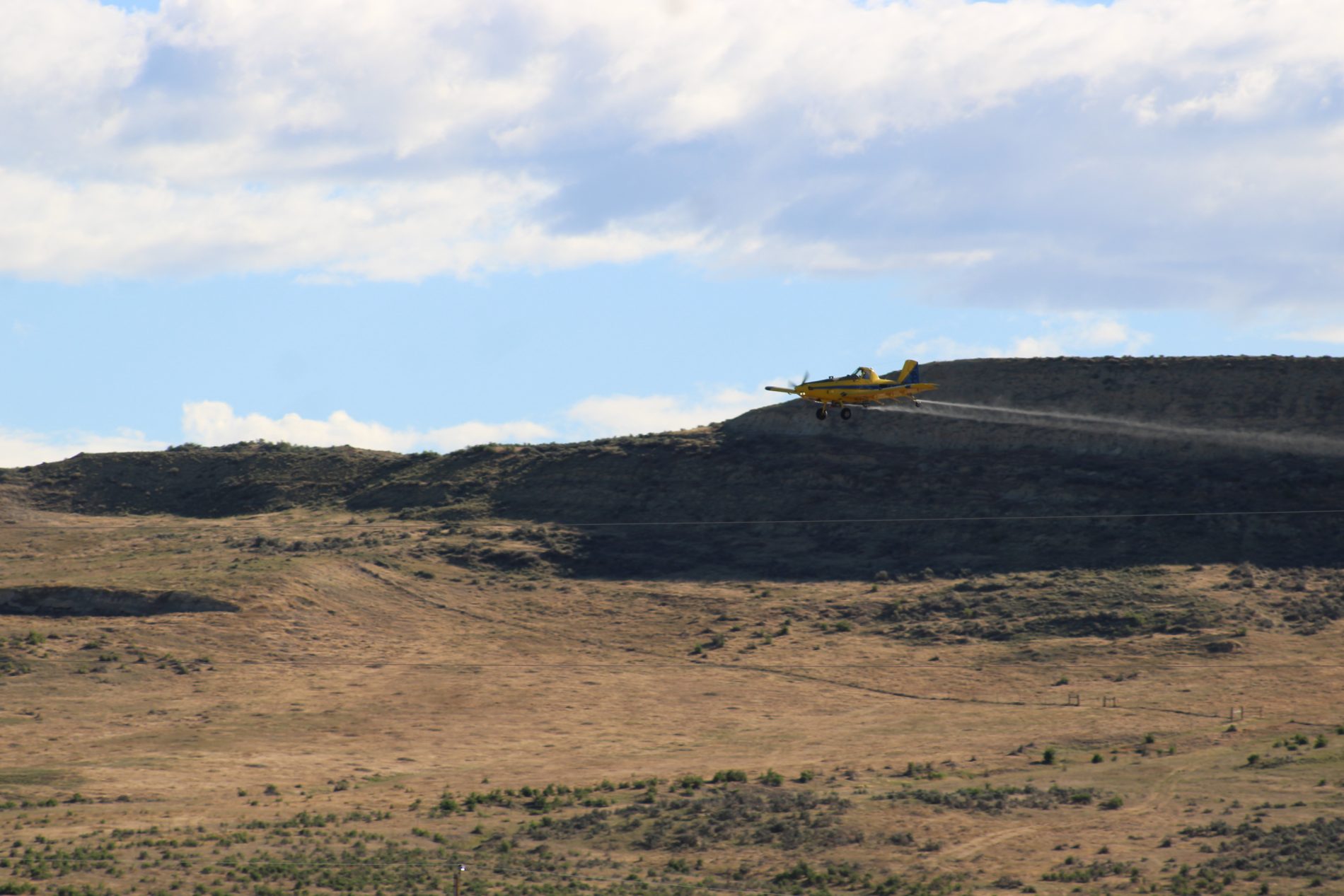
Today, with the better methods of grasshopper control, such as spraying, grasshoppers can be controlled. Around the first of June, the SCWP had an airplane spray near the Sheridan-Johnson County line in eastern Sheridan County. Walker Billings talked about the spray program.

He said the spray didn’t kill all the hoppers, but it reduced the number significantly. While we have ways to control the grasshoppers, we probably won’t see such hordes of grasshoppers, but, they can still be a problem for anyone with gardens or farm crops.