News
History: Jackrabbit Depredation in the Early Years

At one time, Wyoming was considered only fit for jackrabbits and sagebrush, as we see in this story in the Wyoming Industrial Journal, January 1, 1902. It is talking about an industrial convention held in Laramie.
A few distinguished gentlemen from other States were present. They had been taught to look upon Wyoming as territory of sagebrush and jackrabbits, of men handy with their guns and free with their whiskey, instead, they found progress and development, culture and refinement. They discovered that Wyoming people are as fully abreast of the times as the people of the East or any other section, and they went home prepared to spread the good tidings, The mineral, the agricultural and the stock-raising possibilities of Wyoming were intelligently discussed and the industrial future outlined. committee was appointed to secure adequate representation of Wyoming’s advantages in the St. Louis Exposition next year, and to place at Cheyenne permanent exhibit of the State’s resources. All these are good things.
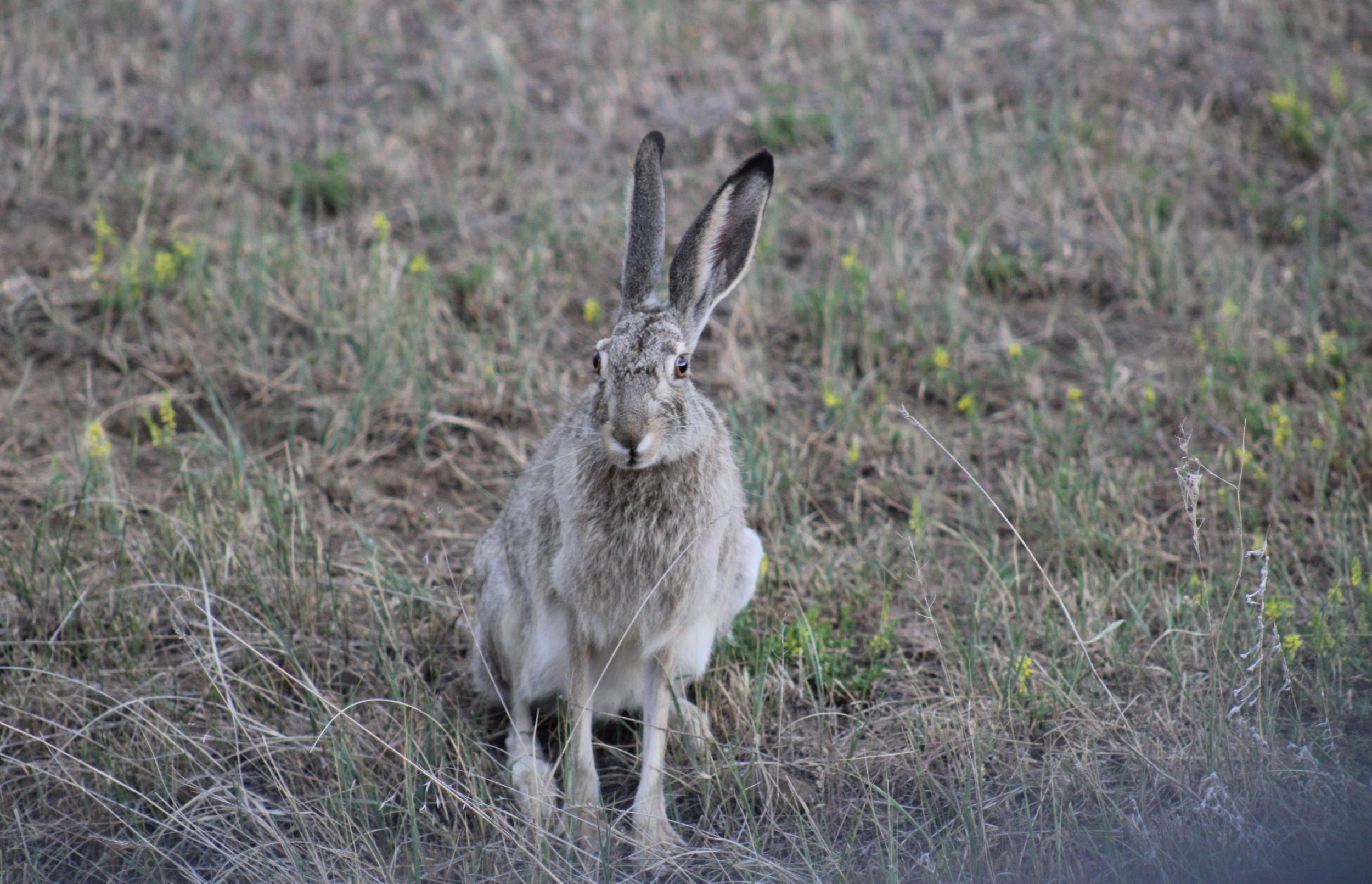
Jackrabbits are as much a part of the western plains as alligators are to the Everglades in Florida. Once called a “Jackass Rabbit,” due it’s long, donkey-like ears, it is a fascinating resident of the arid landscapes of the American West.
There was a time in Wyoming’s past that jackrabbits were so numerous as to be considered a pest by farmers and homesteaders, eating crops and gardens.
There were hunts for jackrabbits, poisons and bounties on the animals to decrease the numbers. It this column we will look back at a time when jackrabbits were hunted to decrease their numbers, and even for meat.
The Centennial Post, December 9, 1905 – Albany Has Rabbit Plague. A peculiar condition is reported from Little Medicine, in the extreme northwestern part of Albany County, says dispatch from Laramie to the Cheyenne Tribune. The ranch men are complaining of the damage done by jackrabbits, which destroy the fields of young grain in the early spring and devastate large areas of alfalfa and other hay during the summer. Now they are feeding at the stacks like cattle, rendering much of the hay unfit to feed to cattle. Hon. Carl Sieverts, large ranch man of that section and member of the last state legislature, says the bounty law is responsible in measure for the rapid growth in numbers of the jackrabbits. Coyotes and wolves are their natural enemies, and until the last year or so were numerous enough to keep the rabbits down to where they did little harm. The slaying of these predatory animals has permitted the rabbits to breed unmolested and now they overrun the plains, with nothing to molest them and no way of checking their increase. There is talk of organized effort with dogs and guns to rid the section of part of the large number of jack rabbits, of which the ranch men complain.
In some areas jackrabbits were extremely numerous, as we see in this story.
The Laramie Republican, January 5, 1912 – Great Slaughter of Jackrabbits – S. C. Downey and Frank Boaler returned last night from Wakeeney, Kas., where they had been for few days on business. Mr. Downey says on the day he was at Wakeeney there were presented for bounty 87,237 jackrabbits, which the farmers of that section had killed, the county paying 5 cents each for the rabbits. The fund for the payment of bounties was exhausted and the next day fully ten thousand more rabbits were presented. The county clerk burns the scalp and ears, the remainder of the carcass of each rabbit being thrown away. They are becoming pest and the farmers are figuring on some way of exterminating them.
Poisons were also used to control the jackrabbit populations.
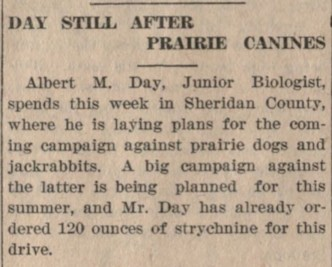
The Branding Iron, Laramie, February 19, 1924
Wallace Vannoy, whose family homesteaded near Clearmont, said that in the early 1930s, they would catch jackrabbits from horseback using a long pole and a wire snare on the end, and make some money off the bounty paid for them.
At one time the meat was considered a delicacy back east.
This from the Moorcroft Democrat, January 28, 1916 – Shipping Jackrabbits to N. Y. John Nelson is in receipt of a letter from the commission firm in New York City to which he had consigned his recent shipment of jackrabbits, 300 pounds. In the letter the firm says that it was greatly pleased with the shipment from Deadwood and that the rabbits were in great demand, readily selling at top prices, the firm not having them on its hands for a single day, and a demand for them was at once created. The firm has asked John if he cannot arrange to ship it a car load of the rabbits, stating that the Black Hills product is topping the market by 12 ½ cents over those furnished from the east for the people who have eaten of them have found them of a different and finer flavor and are demanding that the firm continue to supply them “Deadwood” rabbits, which they consider a luxury. Saturday a party left for the country around Belle Fourche and St. Onge inautos and to remain in thosesections over Sunday, killing all the rabbits that they run across, and John expects that the carload will be secured before the end of the week. The profit that was made from the first shipment of 300 pounds has been such as to encourage the hunting of the rabbits for shipment, and as they are just too plentiful in the country around St. Onge and all of the section under the ditch, there is little danger that they will become exterminated. — Deadwood Pioneer-Times.
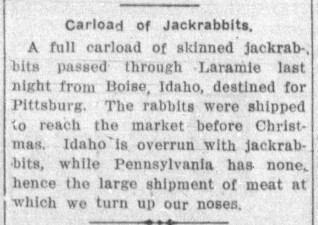
Laramie Daily Boomerang December 14, 1911
Jackrabbits are pretty fast critters. Much faster than a cottontail, according to this article.
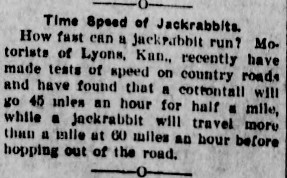
Colony Weekly News, Colony, Crook County, October 12, 1921
In some parts of Wyoming today, jackrabbits have died off to mostly to tularemia, a disease that can decimate populations of jackrabbits and cottontails. They do seem to be making a slow comeback again.
But, at one time they were extremely numerous in many areas of Wyoming, and were considered a pest.