News
History: Wild Horses in the West

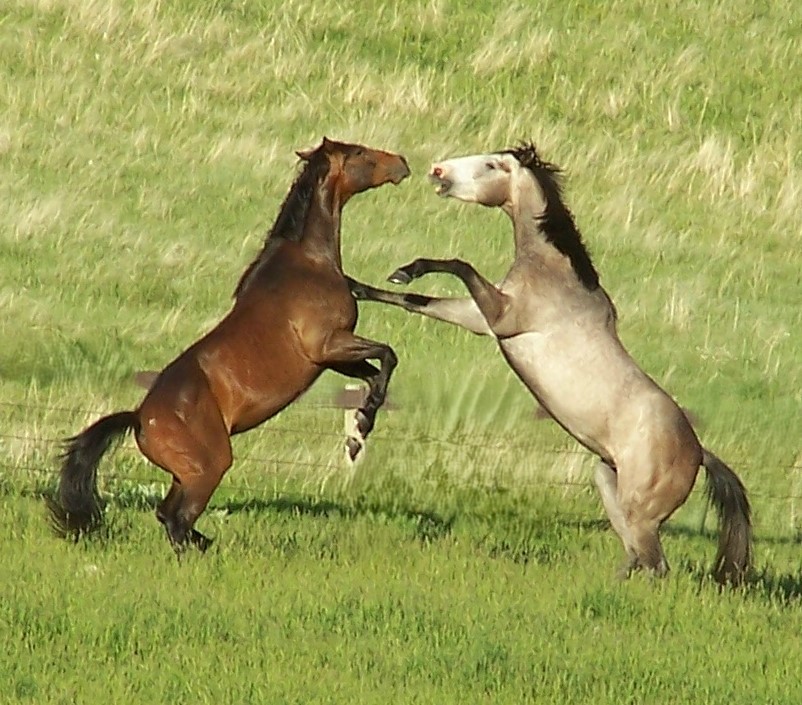
At one time wild horse roamed over much of the west and were numerous on the open plains. Today, wild horses can be seen in select areas of the United States. There are protected herds of wild horses in Wyoming; on the Red Desert near Rawlins, the McCullough Peaks Herd Management area near Cody, and the Pryor Mountains on the Montana-Wyoming border.
But, they did not always have government protection as they do today. In fact, in some cases they were activity hunted or rounded up and sold for slaughter. But many were captured and used as rodeo buckers, or trained and used as riding horses.
So saddle up for a look at wild horses in the early days in Wyoming.
There were some creative ways of catching the wild horses, this was one of them.
Cheyenne Daily Leader, October 23, 1904 –Run Down by Dummy Man -Smooth Scheme of Thermopolis Cowboys to Capture Wild Outlaw Horses. Caught one of Herd, placed a Scarecrow on Back and Let him Chase Outlaws Until They Were Exhausted. – A peculiar wild horse hunt occurred in the vicinity of Thermopolis last week, the unique feature being that the animals were pursued and run down by a dummy man. A bunch of about thirty head of outlaw horses has been causing the ranchmen of the section considerable loss because they would surround a domesticated animal and compel it to run away. Domesticated horses thus taken never returned, for in a short time they became as wild and independent as their captors.
Last week William K. Carson and several friends were offered a substantial sum by the ranch men if they would run down and capture the outlaws. They undertook the job and raised the animals on the morning of the first day but were unable to run them down. They did, however, capture one little pinto of great speed, which became cornered in a ravine.
After resting overnight, the men were about to take up the chase again when Carson was seized with a brilliant idea, an idea that really was a stroke of genius. With clothing from his own back, and from the backs of his companions, he constructed a dummy man, life-sized and very realistic. The pinto outlaw was then saddled and the dummy tied in an upright position on its back. The pinto bucked for some minutes, but was unable to get rid of its burden.
Leading the pinto, the party took the trail of the outlaws and soon sighted them. The pinto was turned loose and immediately broke for his old companions, who, upon seeing the figure upon its back, broke and fled in fright. The habits of wild horses were well known to Carson and his companions, and they retired to the top of a hill to await developments. As they had expected, the outlaws made a circle of several miles and passed close to where they had first began their flight. The pinto was following and had gained slightly. For eight hours the race around the hill continued, the pinto and his supposed human rider always in the rear. At last, when the outlaws were exhausted, the men took up the chase and had no difficulty in running the entire bunch into a corral. Not only did Carson and his friends receive the reward offered by the ranchmen, but they will derive a tidy sum from the sale of the outlaws as soon as they can be broken to saddle.
A less creative was way using relays of horses to tire out the herd so they could be captured in a corral or by roping.
The Laramie County Times, April 22, 1905 – There are said to be from three to four thousand wild horses, or partially wild horses, in Routt County, Colo…says the Saratoga Sun. These horses have strayed from the ranch men of that and neighboring counties and have survived wonderfully in the incomparable ranges that abound in Western Colorado. An expedition has been organized to round ‘ up these horses and, after halter breaking them, ship east to the horse markets to be found there. Frank Cunningham and Joe Peryam left Sunday, each with a string of horses, to join the expedition. The party will be composed of sixty men with four mess wagons, each man will provide his own horses and perform his part of the work of the round-up, corralling and breaking the animals, after which they will be driven to the road and shipped. Each man pays one dollar a day to the wage he messes with, and all other expenses incurred in handling the horsed it is to be shared equally, after which the proceeds realized are to be divided equally.
Sometimes, the stallions were named, as this story about one near Thermopolis.
Cheyenne Daily Leader, April 7, 1908 – Bill Bailey A Prisoner. Celebrated Outlaw Stallion Of Big Horn County is Caught. Run Down by Six Thoroughbreds Working Relays, After A Chase Of Eighty Miles. – Special to The Leader – Worland, Wyo., April 6— “Bill Baily,” the celebrated wild stallion that has ranged in the Honeycomb country, south of the Nowood and Tensleep. for years, defying numerous efforts to capture him, is at lastin a corral and will be used for breeding purposes when sufficiently tamed by association with domesticated horses. Bill Bailey was caught by men in the employ of Mark Warner, leading six men mounted on thoroughbreds and working in relays a chase of eighty miles before he finally became exhausted and was roped. He is a splendid animal, offspring of a blooded mare belonging to Colonel W.F. Cody (Buffalo Bill) and a wild stallion. He is considered easily worth $1,000, and Warner is highly elated over his capture.
This was a follow up from The Worland Grit, October 22, 1908
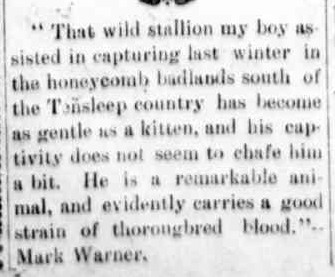
Although this stallion was said to be the offspring of a ‘blooded mare,’ many ranchers would turn a Thoroughbred, Morgan or other purebred stallion in with the wild herds as a way of upgrading the mustangs. They would then roundup the horses and train the promising youngsters for work on the ranch.
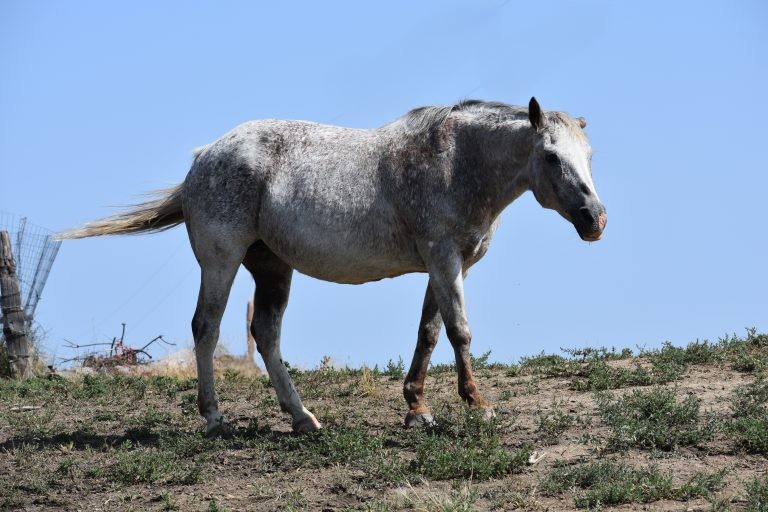
The Semi-Weekly Boomerang, October 7, 1901 – Seeking Wild Horses. Rawlins, Wyo., Oct. 1.—Charles J. Wagers is now gathering wild horses in the Haystack mountains. It is said there are large numbers of mustangs running wild in that section. A number of branded horses that have strayed from neighboring ranches have joined the wild horses and an effort will be made to capture these. It is supposed that the herd of mustangs was started by a small band straying away from a ranch and remaining in the mountain parks, where they have been breeding and growing more wild from year to year. It is said there are some beautiful animals in the band.
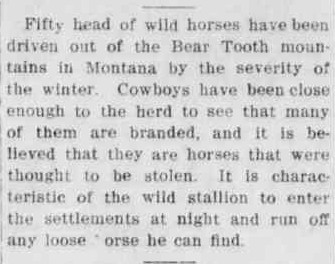
The Sheridan Post, February 19, 1909
Unfortunately, sometimes the solution was to shoot the stallions that raided the rancher’s horse herds. Since the country in those days was not fenced, except corrals near the headquarters, and the horse herd ranged freely on open range, it was easy for a wild stallion to swoop in and entice the ranch horses to join with their wild brothers. No saddles, no bridles, no men, no work moving the wild cattle? Sign me up!
This from The Democratic Leader (Weeklyed.), November 27, 1884 – Parties Organizing for the Purpose of Killing Stallions. Horse Raisers in Wyoming Lose Valuable Stock. One of the Novelties of Western Ranch Life. Up in Northeastern Wyoming and in Northwestern Nebraska many bands of wild horses still roam as fearless and as fleet as in the days when the country was an unexplored wilderness, a terra incognito to the white man, and inhabited only by the Sioux, the Blackfeet and the Crow Indians. Keen to scent the approach of foes, fleet as the antelope that may often be seen browsing in security at their side, and free as the winds that sweep their prairie home, they have successfully eluded the pursuit of cowboys and escaped the destruction the white man’s rifle has meted out to the buffalo and the game of the West. One would naturally think that no animals that roam the plains would be less inimical to the industries of the region than the fugitive bands of wild horses and it will surprise many to learn that parties have been organized in this city for the express purpose of killing the wild stallions.
Year by year horses are lost from the bands in the Territory. Some of them are found, but when mares escape, they are lost beyond reclaim. When wander over the plains they descry a band of horses grazing in some distant valley or outlined from the summit of some hill. They approach the band in equine curiosity, and from that day they belong to no man.
The wild stallions are the guardians of the bands. Always on sentinel duty, they give the alarm when any foe of their liberty approaches; in a moment the stragglers are rounded in, a fleet footed stallion leads the band and with others at the flanks and at the rear away they go in thundering charge. Be the cowboy mounted ever so well, no horse bearing a burden can overtake the riderless ones, and so it has come about that the herds of wild horses have increased instead of diminished in numbers during the past few years. It has been observed, however, that few if any colts are to be seen among the bands during the autumn and winter, and one naturally wonders what becomes of the natural and regular increase of the horses.
The answer is simple. In the spring and early summer cowboys and professional horse hunters go out well mounted for the express purpose of catching the young colts. A band of wild horses is located. They are watched, perhaps for days. When a favorable opportunity is offered the men sweep down on them. Unable to keep pace with the grown horses, easily winded and not thoroughly alive to danger, the colts soon lag behind; a lariat suddenly hisses through the air with unerring aim—and the colt is a captive.
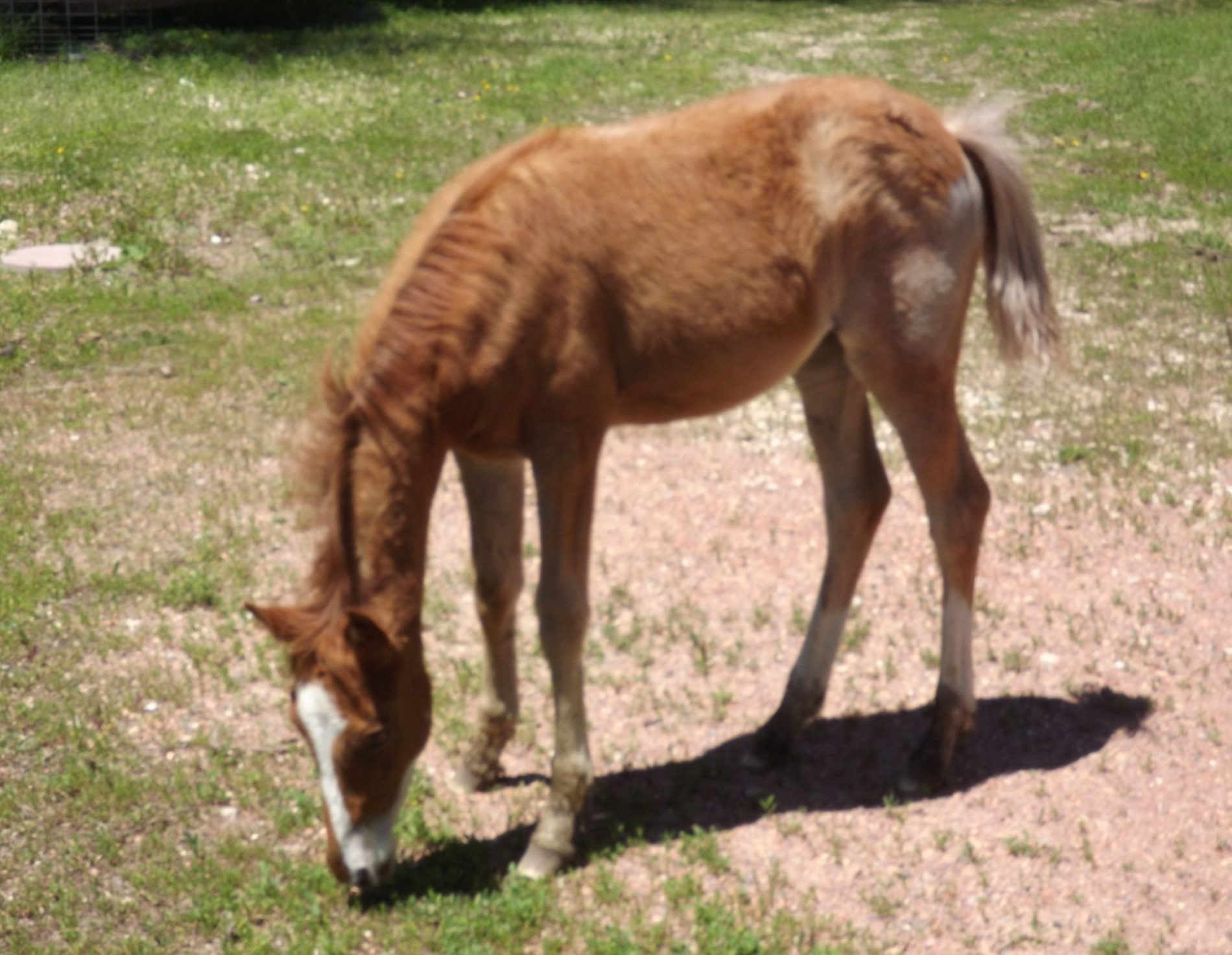
Taken to some ranch the colt is fed milk for some time. It soon adapts itself to the change in its food and readily be comes a pet, more affectionate and dependent than those of its kind born in captivity. Hence the professional horse hunters are rather pleased when recruits are made to the wild horses through the escape of domestic ones and the stallions, which alone prevent the capture of the wandering horses, become special objects of kind solicitation on the part of the hunters.
The loss of mares sustained by various horse breeders has at last become so large that some measures must be adopted to reclaim them and also to prevent further loss if possible. From the horse ranch of Hon. M. E. Post, situated about fifteen miles northward of the city, nearly two hundred mares have wandered away, and of that number it is thought fully one hundred are now with the wild horses. Other horse raisers have suffered proportional losses, and so it has come about that an organized effort will be made this winter to exterminate the stallions, for once rid of them entire bands may be rounded up and secured.
To that end a party of hunters will soon leave for Northeastern Wyoming. They will go aimed with long-range rifles and will carry a large supply of forage, so that their horses may be well fed during the winter. The rest is easy. Mounted upon their grain-fed animals the hunters will pursue the wild bands when they are somewhat weakened by the rigors of winter. Riding as close as possible the hunters will then shoot down the stallions from time to time. By this means it is hoped that by spring nearly all of the stallions will be killed and the capture of the mares thus be made possible.
Today, wild horses are protected. Thanks mainly to the efforts of Velma B. Johnston, also known as “Wild Horse Annie,” Congress passed the Wild Free-Roaming Horses and Burros Act” (Public Law 92-195) protecting the wild herds of public lands. President Richard M. Nixon signed the bill on December 18, 1971.